At a moment when antisemitism is rising nationally and Jewish students increasingly report feeling isolated or misunderstood in school environments, Jewish Federations of North America’s Student to Student program operates on a simple but profound premise: prejudice frequently grows in the absence of familiarity. The most effective antidote to stereotypes and misinformation is relationship-building and personal encounters.
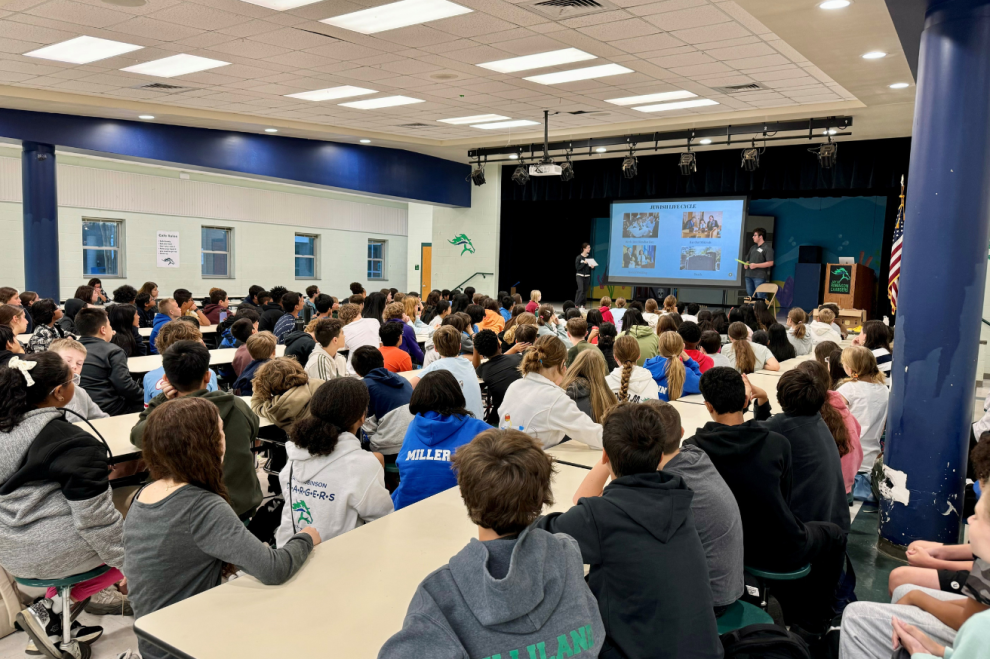
Through the program, Jewish high school students enter classrooms and share what it actually means to be Jewish in America today. They speak not as lecturers or historians, but as peers. They discuss holidays, traditions, family stories, identity, antisemitism, Israel, and the lived experience of being Jewish in contemporary society.
The result is often transformative.
In Charlotte, North Carolina’s Stan Greenspon Holocaust Center, I witnessed the program build something uniquely powerful: authentic human connection.
What distinguishes the program is not simply the information shared, but who is sharing it.
Jewish teens themselves become educators, ambassadors, and bridge-builders. Student presenters answer difficult questions candidly and thoughtfully while modeling confidence in Jewish identity and public engagement. The presentations often include ritual objects and visual aids such as Torah scrolls, mezuzot, yarmulkes, and challah, helping students encounter Judaism not as an abstraction, but as a living culture and community.
Since becoming the Charlotte-area lead for Student to Student in 2020, the Stan Greenspon Holocaust Center has expanded the program into a growing regional educational initiative that now reaches students, educators, and school systems throughout North and South Carolina.
During the 2025–2026 academic year alone, Student to Student presentations reached more than 1,000 students and over 100 educators across schools including South Mecklenburg High School, Palisades High School, Ballantyne Ridge High School, Fort Mill Middle School, Community House Middle School, and the North Carolina School for the Deaf.
That comes on top of the 21,700 total students reached across 22 Student to Student communities during the 2024-25 school year. The 574 Jewish teen participants gave 532 presentations in 177 schools, and preliminary data for the 2025-26 school year indicates tremendous growth ahead.
The impact extends well beyond the classroom.
Here in Charlotte, Student to Student participants have presented to educators during Charlotte-Mecklenburg Schools Holocaust elective professional development trainings, helping teachers better understand how to create responsive and welcoming environments for Jewish students.
Students also participated in the Charlotte Yom HaShoah commemoration, represented Jewish youth perspectives during a statewide elected officials’ breakfast hosted by the Jewish Federation of Greater Charlotte, and spoke to educators from four states during the Greenspon Center’s Fall Day of Learning in partnership with Brandeis University.
This year, three Charlotte-area Student to Student participants were even recruited by Facing History and Ourselves to be interviewed for national educational resources on Jewish identity that will be utilized across the country.
Educators consistently describe the experience as one of the most meaningful components of Holocaust and antisemitism education.
One teacher shared: “This student-to-student connection has profoundly expanded my classes' perspectives by bridging the past with the present and replacing preconceived notions and ignorance with authentic understanding.”
Public school students have also noted the impact, with one 10th grader sharing: “I learned today about the values of Judaism and that the community is its center.” An 11th grader stated, after participating in another presentation: “I learned a lot about the hatred of Jews and the false assumptions made about them that are obviously not true.”
Importantly, Student to Student aligns directly with emerging educational needs across North Carolina. As school districts implement the state’s Holocaust education standards and Holocaust elective coursework, administrators and educators increasingly seek trusted community partners capable of helping students understand Jewish identity in nuanced and contemporary ways.
The Stan Greenspon Holocaust Center is uniquely positioned to meet that need.
The program also demonstrates the broader communal value of Federation-supported beneficiary agencies. Through strategic investment, the Jewish Federation of Greater Charlotte helps empower initiatives that strengthen Jewish life, deepen civic understanding, and proactively address antisemitism before incidents escalate into crisis.
And the opportunity for growth is significant.
According to program leadership, Student to Student could realistically expand to reach upwards of 5,000 local students annually with the addition of another educator dedicated at least 50 percent of their time to the initiative. That expansion would dramatically increase the Center’s ability to engage schools, train additional student leaders, and meet growing demand from educators seeking meaningful antisemitism and identity education resources.
At its core, Student to Student is about building belonging. Yet, in most cases, it also helps to combat hate.
It allows Jewish teens to stand proudly in their identities while giving non-Jewish students an opportunity to encounter Judaism through curiosity, empathy, and relationship. In an increasingly polarized educational landscape, that kind of encounter may be one of the most important forms of education we can offer.
Douglas Greene is the Director of Jewish Community Relations at the Jewish Federation of Greater Charlotte.
Source materials provided by the Stan Greenspon Holocaust Center.