
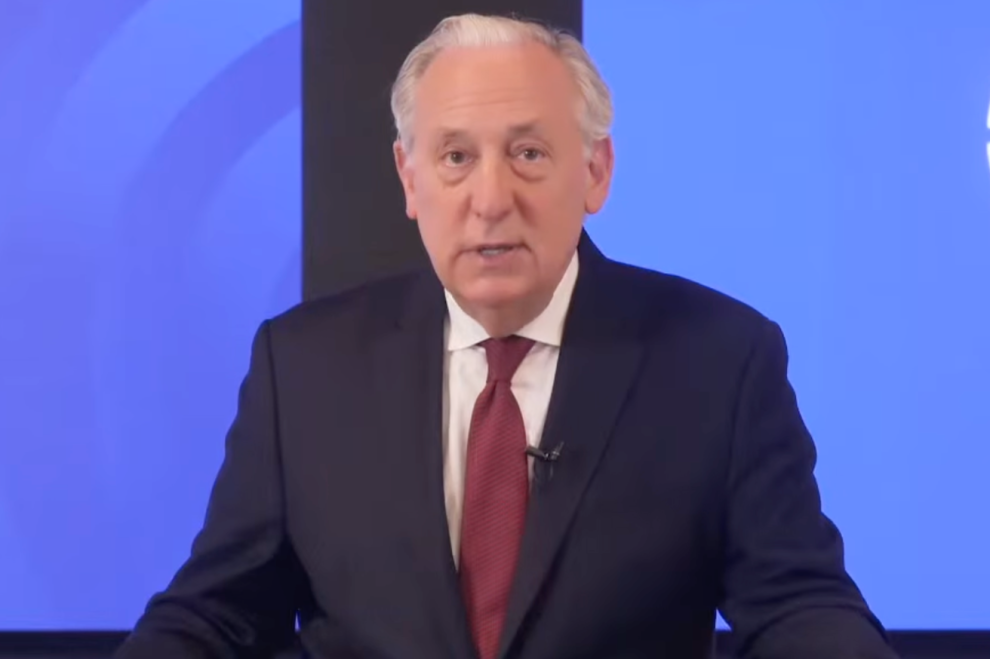
In Thursday's inaugural State of the Jewish Union address, Jewish Federations of North America President and CEO Eric D. Fingerhut called on Congress to take specific actions to secure the Jewish community and shore up the social safety net, while also calling on governors to support educational tax credits.
“We face unique challenges in this moment, especially relating to the rise in antisemitism and the security of our community,” Fingerhut said in the address, which outlined the policy priorities of the mainstream, organized Jewish community. “We know Congress believes in our first amendment right to practice our faith freely. Unfortunately, our ability to exercise this right in 2026 depends on comprehensive, even extraordinary, security precautions. We urge you to make this a matter of highest priority in this legislative session.”
Last year Jewish Federations reported to Congress that the Jewish community is collectively raising and spending over $765M per year on security, and that figure only continues to grow. No other ethnic or religious groups in America is subject to this “Jewish Tax” to protect themselves every day in every setting.
Fingerhut called on Congress to protect the Jewish community by:
- Funding the Nonprofit Security Grant Program at $1 billion
- Providing dedicated federal funding for security personnel
- Enhancing FBI capabilities to detect and disrupt domestic terrorism
- Increasing support for state and local law enforcement
- Holding social media platforms accountable for spreading antisemitic hate, and work to protect Jewish teens and children from growing online risks
- Prosecuting hate crimes aggressively to ensure accountability and deterrence
Despite the challenging security environment, Fingerhut emphasized that Jewish communities must continue to invest heavily in flourishing Jewish life. Federations, he said, have a plan to double the capacity of Jewish day schools and camps over the next decade – even as the community confronts rising antisemitism and growing security needs.
Hen noted that Jewish Federations also sit at the heart of our communities' social service network, supporting families in crisis, funding mental health care, and delivering services that meet people where they are.
That is why Federations are closely monitoring policy changes to programs such as Medicaid, SNAP, and the Older Americans Act to ensure they do not unintentionally harm vulnerable individuals or undermine the stability of essential services.
Fingerhut also called on Congress to pass several pieces of legislation:
The bipartisan Protecting Students on Campus Act of 2025, which would require federally funded colleges and universities to clearly inform students of their civil rights under Title VI and provide accessible information on how to file discrimination complaints.
The WISH Act, a bipartisan proposal which would establish a federal long-term care insurance benefit to provide a federal backstop while encouraging private long-term care planning.
The bipartisan SSI Savings Penalty Elimination Act, which would raise the asset limit on Medicaid so that low-income seniors and people with disabilities do not lose essential benefits simply for saving a small emergency fund. The bill would modernize these limits, raising them to $10,000 for individuals and $20,000 for couples and indexing them to inflation going forward.
The Credit for Caring Act, which would create a federal tax credit of up to $5,000 to help working family caregivers offset out-of-pocket long-term care expenses deserve strong support, and we welcome other ideas as well.
While Jewish Federations are spending more on security than ever before, the organization continues to invest aggressively in Jewish life, while also looking elsewhere and look elsewhere for continued investment, such as the new federal Education Tax Credit, and are urging all 50 states to opt in so funds can reach families and schools in their communities.
Following the address, a panel of Jewish leaders from across the country added their insight into what’s happening on the ground in their communities.
“On the antisemitism front, we're definitely seeing an uptick,” said Rabbi Noah Farkas, President and CEO, Jewish Federation of Greater Los Angeles. “And some of it is violent, but at the same time, we're seeing a very strong community response, and that includes security ... and [that has] required a much more robust gathering, coordination and convening that the Federation has been doing since 2022 around the areas of antisemitism and security.”
Farkas added that his community has seen a rampant rise in systemic antisemitism in the entertainment guilds and that the Los Angeles Federation is working with the guilds to root out that antisemitism and advocate for Jewish life.
“Our budget six years ago was zero for security ... this year it’s $2.4 million,” said Miryam Rosenzweig, President and CEO, Milwaukee Jewish Federation. “We're very thankful for the security grants and the Federal nonprofit Security Grant, because it has been a big driver of being able to fund it, as well as incredible philanthropists and the work that has been done through [Jewish Federations of North America]. But ... the sustainability of this long term has been concerning because of the cost.”
“We've had significant population growth, and in Miami, it's skewing significantly younger than the historic model,” said Scott Kaufman, President and CEO, Greater Miami Jewish Federation. “Lots of young people are moving and they're wanting to engage Jewishly, both because they're new in town and they don't have networks yet, where Federation can play a great role.”
You can watch the full speech here, and read the full transcript here.